A Eulogy to Ahjula – Provinces
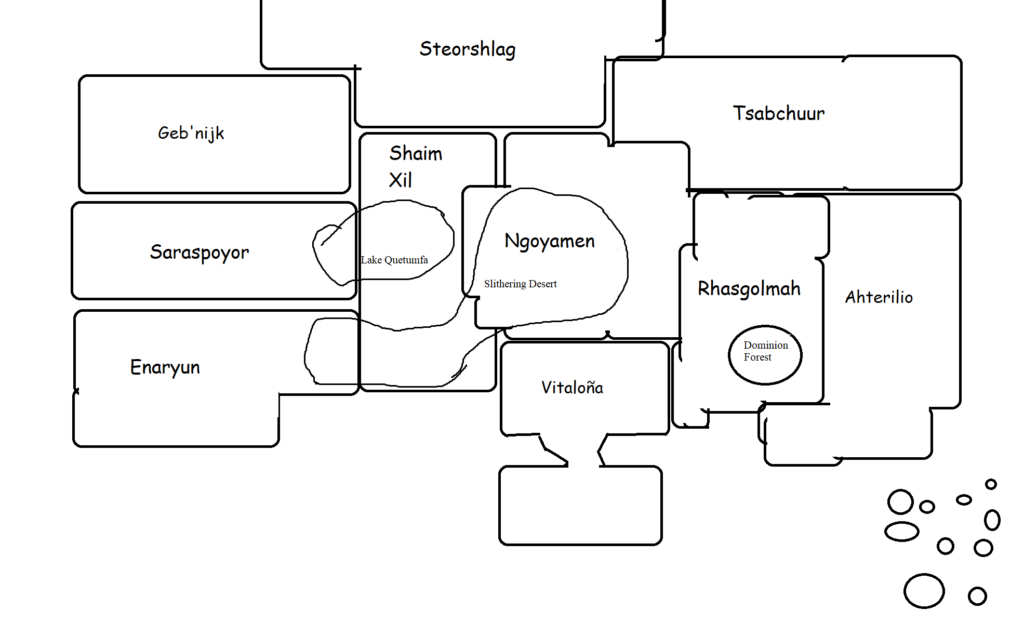
Here I’m going to list the different provinces that exist on the main continent featured in the story, as well as some useful info for each. I’ll start with a very basic image I’ve drawn, to let you see roughly where the provinces are placed and their sizes. It is really blocky and ugly, but I’ll improve it at some point!
Ahterilio
Real-world name inspiration: “Star” in Ottoman Turkish
Regional in-universe name significance: “Home of the sun”
Architectural inspiration: Ottoman/Persian
Adjective: Ahterilonan (but for the Empire itself, they use Ahterilion)
Terrain: Mainly grassy fields and prairies, sunny coastlines, plus the constellation of islands to its east/southeast
Typical architecture: Tiered, often castles with towers and special roads for the upper classes. Spiky walls
Most common battle mount: Griffon
Most common weapon:
Foremost income sources: Farming, fishing, light sea trade and specialized items + reagents from the islands to the east
Famous trait: Previously being the core of the Empire, and the first nation to be fully centralized by one leader
Reputation: Thought of as the strongest and best organized, but also warmongering and callous.
Main type of governance: Nobility and warlords
Local languages: Ahteron (lingua franca of the continent)
Largest cities: One in the north (Thesurisa), one in the southeast (Nova’keshmir) near the coastline and one in the center (?) somewhat west of the previous capital in the east (Dimasterius)
Pillars of Concord: Ennius Coladeus Bayezild (Sun lord of Nova’keshmir), Salman Gulli adibesa Najlano (Crystal Crown of Thesurisa), ??
Other: Contains one of the three known volcanos on the continent, called Ra Veztio Parakdimi (“The Old Splutterer”), placed on the southeastern isles. Ahterilonan lords are the ones who hire the most merc bands, but many lords have their own standing armies too
Ngoyamen
Real-world name inspiration: “Drum” in Swahili and Malay (a.k.a the beating heart)
Regional in-universe name significance: “The beating heart of the land”
Architectural inspiration: Egyptian and Mali
Adjective: Ngoyameni
Terrain: Lots of desert from the Slithering Desert in the west, otherwise steppe and grassland.
Typical architecture: Generally open cities and walls only for specific structures (owned by merchants), extended roofs to protect against the sun
Most common battle mount:
Most common weapon:
Foremost income sources: Farming and market trading
Famous trait: The Kubitauf Market, the largest on the continent, plus being a melting pot of several cultures. Most come this way at some point
Reputation: As it is the center of the continent, with many coming from every corner, thought of to be the most welcoming and adaptive, but also self-serving and greedy, assumed to exploit the people they take in.
Main type of governance: Grand traders
Local languages: Nswarha (northern tongue), Hooshay (central tongue)
Largest cities: One in the west near a major river (?), one in the north (Kambaresa, “Eagle’s Aegis”), one in the central-east where the market is (Mimhor Bashru, or just ‘Bashru’) and one in the south (?)
Pillars of Concord: Fazizir Whillsone ma Goolade (Grand Tradesman), ?? (Lord of the Talon in Kambaresa)
Other: The only non-northern region that is landlocked. Other towns include Shinripala (north) and Werd Anin.
Challenging one’s host is more common here (and Vitaloña) than in other places.
Tsabchuur
Real-world name inspiration: “Patience/Tolerance” in Mongolian and Turkish
Regional in-universe name significance: “The storm-hounded”
Architectural inspiration: Russian and Siberian (mixed with Shades)
Adjective: Tsabchuurian
Terrain: Mountains in the north/northwest, otherwise rather grassy fields and prairies, plus a stormy eastern/northeastern coastline
Typical architecture: Religious-themed ornamentation, major buildings often decagonal, weather-resistant at the coast
Most common battle mount: Griffon
Most common weapon:
Foremost income sources: Mining, hunting, farming and Temple activities
Famous trait: Being the cradle of the Shades of creation, the largest religion in the land, and also contains the largest temples
Reputation: Viewed by many as pious and honest since the Shades derive from here, but also boring and humorless.
Main type of governance: Religious leaders and nobility
Local languages: Vrchuut (South and southwestern tongue), Khanyai (Eastern tongue), Taiah (Northern tongue), Bogbir (Northwestern tongue)
Largest cities: One in the northwest among the mountains (?), one in the east near the sea (Vaarnetii), one in the southwest (Nudtehir) and one in the south (?)
Pillars of Concord: Khaider ain Soleva (The Grand Custodian of the Shades of creation, in Vaarnetii), Dhaltan ayez Maham (Lord of the High Plains of Nudtehir), ??
Other: Generally assumed to be the poorest region, due to no outstanding income source (as Steorshlag does more mining). Some wear feathers of their fallen griffon companions (usually only those who are lucky enough to have one). Just like in Steorshlag, they believe in drinking a lot of large drinks, but tend to be less potent than the south. The Temple teaches people that the ocean to the east contains the rage of Teniyus, which is why it is so treacherous.
Rhasgolmah
Real-world name inspiration: “Gold” and “Beauty” in Arabic and Igbo
Regional in-universe name significance: “Everlasting golden fields”
Architectural inspiration: Arabic (mixed with Ixal)
Adjective: Rhasgolmahan
Terrain: Grasslands, small but warm coast and a gigantic woods to the east, the Dominion Forest
Typical architecture: Ixal carapace ornamentation or shielding, flat, very even between classes
Most common battle mount: Saber
Most common weapon:
Foremost income sources: Advanced farming system, light fishing, selling Ixal and hunting
Famous trait: Their agricultural networks. They were the first to tame the Ixal, when they realized the usage for the large insectoid beasts and even today, they have the largest breeding and selling of Ixal, and they hold the fastest food production.
Reputation: Usually believed to be the best workers and the most straightforward, for all their farmlands, but as a by-product, demeaned as an uncouth and unsophisticated lowborn land.
Main type of governance: Nobility and elected grand farmers
Local languages:
Largest cities: One in the north (Veau’adin me-awah), one in the south (Habujiens) and one in the west (?)
Pillars of Concord: Amruyya el-Fereneau (Prime Holder of Habujiens), Zachorish Uch’eal (Prime Holder of ??), ??, Sulamee el-Uchean (dead, previous Prime Holder of Veau’adin me-awah)
Other: Previously had a city near the Dominion Forest, but the Herd obliterated it.
If one walks further into the Dominion Forest, one can hear a soft and low beating. Some now believe that it may be the head monster of the Shadow Herd, but stories of this low thrum has existed even prior to the Herd’s arrival. In the past, people assumed this was the heart of the forest and therefore an indication of it being alive. Many soldiers in Rhasgolmah work as farmers in between their work
Vitaloña
Real-world name inspiration: “Vitality” in Spanish
Regional in-universe name significance: “Life’s cradle”
Architectural inspiration: Mediterranean
Adjective: Vitaloñan
Terrain: Most of it is lowlands, albeit not everything. Often grassy and quite fertile, sometimes steppe and a little bit of savanna. As it is for the most part a peninsula in the south, they have great access to the ocean and the winds are warm, the skies sunny.
Typical architecture: Open, colorful, possibilities of climbing upon like higher roads
Most common battle mount: Saber
Most common weapon:
Foremost income sources: Fishing, various cultural establishments, farming, sea trade
Famous trait: It’s art and music scene is rather large and draws a lot of attention. Some of the most well-known artists and painters in the continent started in Vitaloña. It is also the most populous region, more so than Ahterilio even.
Reputation: Seen as festive and free-spirited, but hence unpredictable and disorganized as well.
Main type of governance: Successful businessmen and minor nobility
Local languages: Efañelinos (southern tongue), Pordephin (northern tongue)
Largest cities: One in west (Ambocia), one in south (Zaranephon) and one in north, on the “mainland” (?).
Pillars of Concord: Silvera del’vu Nipakvit (Owner of ??), Nubuel Mafejato (Owner of ??)
Other: Challenging the words of one’s host is more common here (and Ngoyamen) than in other regions.
Contains one of the three known volcanos on the continent, known as Imbarisba es Khein (“Unbeatable mound”)
Steorshlag
Real-world name inspiration: “Stone law” in German, various Nordic countries and Korean
Regional in-universe name significance: “The law of the rigid”
Architectural inspiration: Ancient north European + Korean
Adjective: Steorshlagan
Terrain: Somewhat more than half is mountains and hills, most of it snowy and cold. The rest is lower lands, with forests and fields, where a lot of the farming happens
Typical architecture: Robust, heavy, unornamented
Most common battle mount: Direwolf
Most common weapon:
Foremost income sources: Mining, crafting from minerals and ore, farming
Famous trait: Rittmark, the first established knight order. They are still said to be greatest trained singular warriors (but not as an army).
Reputation: Believed to be brave and enduring because of the land they live in, but as a consequence, also as coldhearted as their land.
Main type of governance: Chieftains, chosen by proved strength
Local languages: Skaengir (southern tongue), Goetejul (one of the largest languages, spoken in Gryterhung), Foerngu-en (eastern tongue), Deu-ilt (western tongue)
Largest cities: One in southwest (Nürneol), one in west (Uvatberg), one in the southeast (Umesan), one just above the center (Gryterhung)
Pillars of Concord: Jonaidur Isolttar (First Chieftain of Gryterhung), ??, ??
Other: Like most mountainous nations, a lot of the ore and precious metals are acquired from here. Steorshlag has two of their largest cities in the south, and one up north, which executes and controls plenty of the mining. However, the other cities do not only buy from them, but also mountain clans, that roam further north, which are liable to be slightly cheaper (albeit in smaller quantity). Many drinks served there are large and they drink many of them, but tend to be less potent than the southern drinks.
Contains one of the three known volcanos on the continent in the distant north, but it has no known name.
Shaim Xil
Real-world name inspiration: “Life” and “Stream” in Hebrew and Chinese
Regional in-universe name significance: “The rivers of vigor”
Architectural inspiration: Chinese
Adjective: Xilan
Terrain: Plenty of rivers converge here, plus a major part of Lake Quetumfa in the west (largest in the land), and also some desert to the east
Typical architecture: Integrating rivers into cities, curved roofs and flowing ornamentation
Most common battle mount: ??
Most common weapon:
Foremost income sources: Fishing, farming, escort services and tolls from their trade network
Famous trait: The establishment of enhanced transportation systems – both along the many rivers that float around and out of their lands, but also through improved usage of wagons and ixal, and a stabler infrastructure. They could get many people out of harm’s way during the Shadow Herd’s reign because of this.
Reputation: Built on their trade network, figured as the most efficient and quick-serving, but due to working with so many from other nations, unreliable and treacherous.
Main type of governance: Corporate directors
Local languages: Junvishti (northern tongue), Huanbasi (western tongue)
Largest cities: One in the northeast along one of the rivers (Dezasha, known as “Teniyus wayward daughter” in light of being a port of blue/sky blue), one in the west (Avevshou) and one in the south near the coast (??)
Pillars of Concord: Qian lie xun Shalitem (Chairwoman of the Avevshou Transport Concern), Sadek wun da Tziyon (Chairman of the North River Freight Services), ??
Other: Shaim Xil’s people mainly agreed to serve the Empire as it seemed more lucrative to gain better trading routes. Some also known the province as “The land of a thousand rivers”
Previously had a city in the north of their section of the Slithering Desert, called Dumazhasi, which was destroyed by the Shadow Herd, currently known as one of the “Forsook Cities”.
Xilan city guards are known for being quite crafty and stealthy, watching the ones they mean to fight or arrest for a while, prior to striking.
Other towns include Jingtanya (east).
Geb’nijk
Real-world name inspiration: Inspiration: “Earth” from Polish and “Herald” from Russian
Regional in-universe name significance: “Guarded by the soul’s soil”
Architectural inspiration: Center-east and northeast European, but also mixed with elven from mythology
Adjective: Geb’nijki or Nijki
Terrain: Some mountains in the north, but otherwise thick woods and tundra
Typical architecture: Built into the terrain, generally forests. Utilizes trees both as walls and sometimes hollowed-out as buildings, underground escape tunnels
Most common battle mount: Direwolf
Most common weapon:
Foremost income sources: Mining, tree farming, and banking
Famous trait: The creation of the Merchant’s Association, the largest guild that handles banking and merchant collaborations
Reputation: Figured as the most calculating and careful as they are the banking land in the forest, but because of where they live and how they act, also believed to be mysterious, suspicious and unclear.
Main type of governance: Banking custodians and minor lords
Local languages: Belski (Central tongue)
Largest cities: One in the south (Vandustok), one in the southeast (?) and one in the middle (Wrocinsk)
Pillars of Concord: Braginove Sepkowski (First Chair at the Wrocinsk State Bank)
Other: The thick woods consisting of Dusdtuba – “Souloaks”, resilient, enormous and extremely girthy trees, strong as rock – of the region were very useful when defending against the Empire, but it did not do much to stave off the Shadow Herd’s advance. At least half belonged to the Empire previously, but not through conquest – they offered great deals of financial independence to the Merchants Guild, that swayed them.
Saraspoyor
Real-world name inspiration: “Saraswati’s foot” in Hindi and Uzbek
Regional in-universe name significance: “Wisdom’s first step”
Architectural inspiration: Indian + Aztec
Adjective: Saraspoyori
Terrain: Mountains to the west, otherwise tropical woods and steppe, plus part of Lake Quetumfa (Quetzalcotl + “breath” in Hausa) in the east (largest in the land), and swamps in the south to Enaryun
Typical architecture: Rounded or spiral shapes, towers
Most common battle mount: Raptor (said to have emigrated from the west)
Most common weapon:
Foremost income sources: Mining, farming, and academy activities
Famous trait: The Prtaliza Academy, the largest and oldest (known) school on the continent, sat by the foot of the mountainside to the west, established before the Empire’s conquest. It did grow thanks to imperial funding, though.
Reputation: Trusted by many as the most educated and sophisticated, but furthermore figured as weak and submissive.
Main type of governance: Nobility
Local languages: Torundi (Western and central tongue), Berautl (northeastern tongue), M’ech’i (southern tongue), Buzenkl (northern tongue)
Largest cities: One in the west where the academy is (Tetzidabad), one in the south (Bengahircuan), one in the northeast (?) and one in the east (?)
Pillars of Concord: Ixcale Chim’raj Dhitua muk Rhoshal xico (Archguru of the Omni-spires in Senuazarkand and Senior Councilor of the Prtaliza Academy Committee) Other: The Everflowing Library in Prtaliza is the largest in the continent and contains some of the most ancient of scriptures anywhere, some even in languages that can no longer be read. Unfortunately a big chunk of its historical knowledge was destroyed when the Shadow Herd shattered its tower. It contained some of the oldest texts from over a thousand years ago.
Public executions are not distributed in Saraspoyor, as it’s considered barbaric, and even in private, it’s fairly rare for the death penalty to be a factor.
Enaryun
Real-world name inspiration: “Inari’s finger” in Japanese
Regional in-universe name significance: “Giver of prosperity”
Architectural inspiration: Southeast Asian
Adjective: Enaryunan
Terrain: Sparser built woods, swamps and marshes to the north, mountains to the northwest, some desert to the east and a warm coastline
Typical architecture: Several sets of walls, massive gates and walls with pockets for archers
Most common battle mount: Marsh iguana in the swamps (great swimmers), raptors in the desert
Most common weapon:
Foremost income sources: Fishing, farming, mining, sea trade
Famous trait: Best known for being the largest ocean presence (although even that is rather diminutive) and the Juhtsuri Celebration – a week-long festival dedicated to genial competition. It’s a derivative of a more ancient festival from the past, but has changed, particularly under the Empire’s duration. While the Shadow Herd ravaged the land, there was no time for it and it was almost forgotten completely, until the Temple and government of the east remembered and brought it back, twenty years or so after the Herd’s diminishment. It was mainly just for regional people first, but more have been drawn there since.
Reputation: Considered by others to be sturdy and unbeatable, as most never surrendered to the Empire, but therefore generally unruly and untrustworthy, refusing to work with others.
Main type of governance: Nobility (who are also religious leaders)
Local languages: Suhengi (northern tongue)
Largest cities: One in the southwest, one in the east (Kuki ytta sini Nänoya shin or “Kukilnoya”) and one in the north (Yoko hien lyä Oulen or “Yokolen”)
Pillars of Concord: Okimura Mizuke nå Kevalen (Father of the Sixth Earthly Portal, in Yokolen), ?? ?? töp Dieza (Mother of the Fourth Earthly Portal, in Kukilnoya), ??
Other: The Empire had certain troubles penetrating Enaryun due to the desert in the east, its swamps in the north and the usage the locals make of it, plus that they were one of the few who often banded together to ward off foreign invasions. At least the east eventually gave in due to political pressure, though. To this day, they are somewhat resented for this by neighbors, out of jealousy when Enaryunans act proud.
The marsh iguanas are known as Kiipeelinizä, “water climber” (taken from “water” in Japanese and “climber” in finnish)
Their regional religion is known as Ka’i Ikulen Tensikake, “The Eternal Heavens” (taken from “heaven” in Yucatec mayan, “eternal” in finnish and “heaven” in Japanese), but is better known as Togujala Uchi ava Loishieru, “the resplendent portals to the gods’ embrace” in Yokolen (note: a tidbit to this is that Enaryun is actually kind of correct in their ‘humanity and nature as one’ belief, as well as that humanity did pass through gates to enter this planet. It’s one of the flawed remnants from their arrival – they started believing that if they appease the dragons, they can return home, which turned into “if we appease the gods, we can go to heaven”. The nature part is one that Ahjula taught the first generation). Outside Enaryun, it’s simply known as “The Heavenly Gates”.
Semojokin is the river that floats down from Shaim Xil through the Slithering Desert and into Enaryun, then onwards to the west. The town Outo juu Wakayanliek, or Outoyan, is built along it
Previously had a city named Huaque Tentun moki aoy Ekka or “Huateokka” on the southern coast, with the Slithering Desert on its northern border, but it was shattered by the Shadow Herd and is currently a Forsook City.
Gold is an important religious color in Enaryun and is viewed as one of the colors of the heavens